Why Standard Deviation Fails in Crypto Risk Modeling
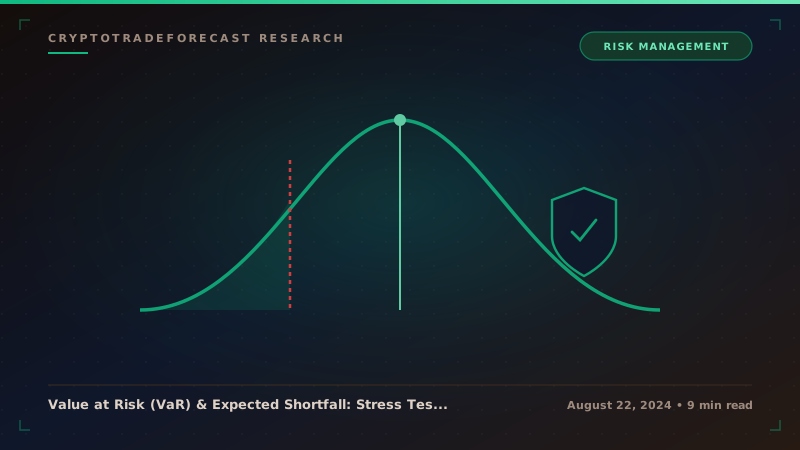
Traditional financial models often assume market returns follow a normal bell curve. Crypto returns exhibit extreme kurtosis ('fat tails') and severe negative skew. Standard deviation alone fails to capture the true magnitude of flash crashes and liquidation cascades.
Interpreting a 1-Day 95% VaR:
If your $100,000 portfolio has a 1-Day 95% VaR of $6,500, there is a 5% probability that the portfolio will lose more than $6,500 over the next 24 hours under normal market conditions.
Value at Risk vs. Expected Shortfall (CVaR)
VaR tells you the cutoff threshold for losses, but it doesn't tell you how bad things get once that threshold is breached. Expected Shortfall (CVaR) answers this by calculating the average expected loss of the worst 5% (or 1%) of scenarios. For risk managers, CVaR is the preferred metric for sizing tail risk.
Practical Portfolio Stress-Testing Steps
- Run historical simulations using actual price data from past major market panics (e. G., March 2020 COVID crash, May 2021 liquidation, November 2022 FTX collapse).
- Calculate portfolio correlation coefficients: remember that during black swan events, asset correlations often move toward 1.0.
- Maintain cash or short-term Treasury reserves to cover maximum calculated Expected Shortfall drawdowns.